In an era where music often follows predictable formulas, H-Lighta (also known as Heavy Lighta, formerly Lighta Soundboy) emerges as an artist who refuses to be confined by genre, geography, or convention. This Afrogerman (German-Sudanese) is part of a new wave of global creators whose work transcends borders while remaining deeply rooted in purpose.
A Sound Without Borders
H-Lighta’s music exists at the intersection of Afrobeat, hip hop, rock, soul, and electronic production—a fusion that mirrors his own multicultural identity. Having lived and worked across three continents—Germany, Sudan, and Asia—his perspective is shaped by genuine global experience, not just aesthetic tourism. But it’s also shaped by something more pointed: the reality of existing between worlds that don’t fully embrace you.
In Germany, despite its surface-level commitment to diversity, he navigated the persistent discrimination that many Afrogerman artists face. Looking toward Sudan meant confronting a country under sanctions and now devastated by war. This isn’t a sob story—it’s context for understanding why independence isn’t just a choice for H-Lighta, but a necessity. When there’s nowhere to turn to, you build your own infrastructure.
The Complete Independent
H-Lighta aka Heavy Lighta (Source: https://heavylighta.com)
H-Lighta handles the entire production process from A to Z—composing, producing, mixing, and often mastering his own work. Working primarily with Linux-based software, including the Ardour DAW and open-source VST plugins, he’s built a completely self-reliant production environment. This isn’t about being trendy or making a political point for its own sake; it’s about choosing as much “freedom” as possible, using Free and Open Source software at the base of production, while creating the workflow you need.
In an industry dominated by proprietary software, major label machinery, and gatekeepers who claim to champion diversity while maintaining the same old exclusions, H-Lighta’s approach is both pragmatic and radical. He’s proving that you can produce professional, compelling work entirely outside conventional structures.
Music as Resistance
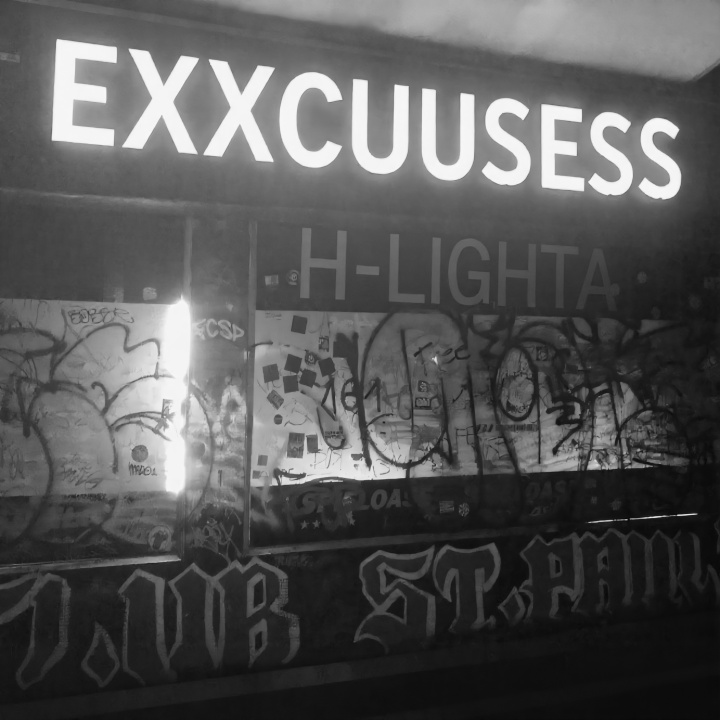
H-Lighta’s work is inseparable from his activism, particularly regarding Sudan and broader questions of social equity across the African continent. His album Let There Be Light doesn’t just entertain; it challenges listeners to engage with urgent issues while maintaining musical craftsmanship that demands attention. Singles like “Excuses” demonstrate his ability to weave complex social commentary into accessible, compelling soundscapes.
His social media presence, particularly on TikTok and Instagram, extends his reach beyond traditional music channels, allowing him to speak directly about conflicts, humanitarian crises, and the politics of resistance. He’s part of a generation of artists who understand that platforms are tools for consciousness-raising, not just content delivery.
Let There Be Light album cover: (Source: https://heavylighta.com)
Excuses single cover (Source: https://heavylighta.com)
Why This Matters
In the landscape of contemporary music, H-Lighta represents something worth paying attention to: an artist who’s building complete creative independence while addressing issues that mainstream platforms often avoid. He’s proof that you don’t need institutional validation or industry infrastructure to make meaningful art that resonates across cultures—you just need skill, commitment, and something real to say.
For those interested in the intersection of technology, global politics, and musical innovation, H-Lighta offers a clear example of how these elements can combine to create work that’s both artistically compelling and culturally necessary.
The Heckler & Koch G3 assault rifle became so deeply embedded in Sudan’s conflicts that it didn’t just arm the fighters—it became their identity. According to conflict researchers, the feared Janjaweed militias took their name from the ubiquitous German weapon that West Germany had systematically distributed across the region.[1] What began as Cold War-era arms deals evolved into something more pervasive: a weapons system so standardized across Sudanese forces that it shaped the very structure of violence in the region.
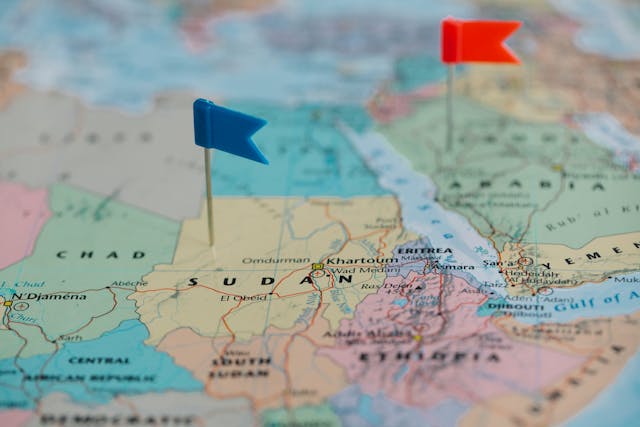
Today, as Sudan endures what the UN calls the world’s largest humanitarian crisis with 14 million people displaced, photographs from conflict zones continue to show both warring factions—the Sudanese Armed Forces (SAF) and the Rapid Support Forces (RSF)—wielding G3 rifles amid the ruins of Khartoum. This isn’t just a historical footnote about Cold War arms sales. It’s an ongoing story of profit, political expediency, and the human cost of turning blind eyes to where money and weapons flow.
Following the money: G3 licensing as a revenue stream
The G3’s global proliferation wasn’t just about selling rifles—it was about creating a profitable licensing empire. As one analysis notes, Heckler & Koch “set up franchises for the gun around the world—for a fee, of course.”[2] Between 1961 and 1982, Germany granted production licenses to countries including Iran, Turkey, Pakistan, Saudi Arabia, Greece, Norway, and Mexico. Licensed production “ran rampant in the 70s and 80s,” with these countries manufacturing millions of G3 rifles under agreements that generated ongoing revenue for the German company.[2]
Over 7.8 million G3 rifles have been produced globally under these licensing arrangements—in at least 15 countries, by some counts 18.[3] Each production run, each component manufactured under license, flows back as revenue to the original rights holder. This isn’t “old Cold War stuff nobody profits from anymore”—it’s an enduring business model where German intellectual property rights continue generating returns from weapons used in conflicts worldwide.
The weapon has been adopted by over 80 national armies and continues to appear in conflict zones from Syria to Yemen, from Bosnia to multiple African wars.[3] When Amnesty International documented G3 rifles in Darfur with Yemeni gunsmiths’ markings in 2024, they were documenting not just old stockpiles but an active network where licensed production, resale, and transfer keeps the G3 system profitable and lethal.[4]
Sudan: Where weapons met migration policy
Sudan’s relationship with German weapons stretches back to 1956, when West Germany used the newly independent nation as the first test case of its Hallstein Doctrine strategy. What followed was decades of militarization. During Sudan’s First Civil War (1955-1972), which claimed at least half a million lives, West German military equipment worth hundreds of millions of Deutschmarks flowed to Sudanese forces—primarily G3 rifles and military trucks, often routed through Saudi Arabia.[1]
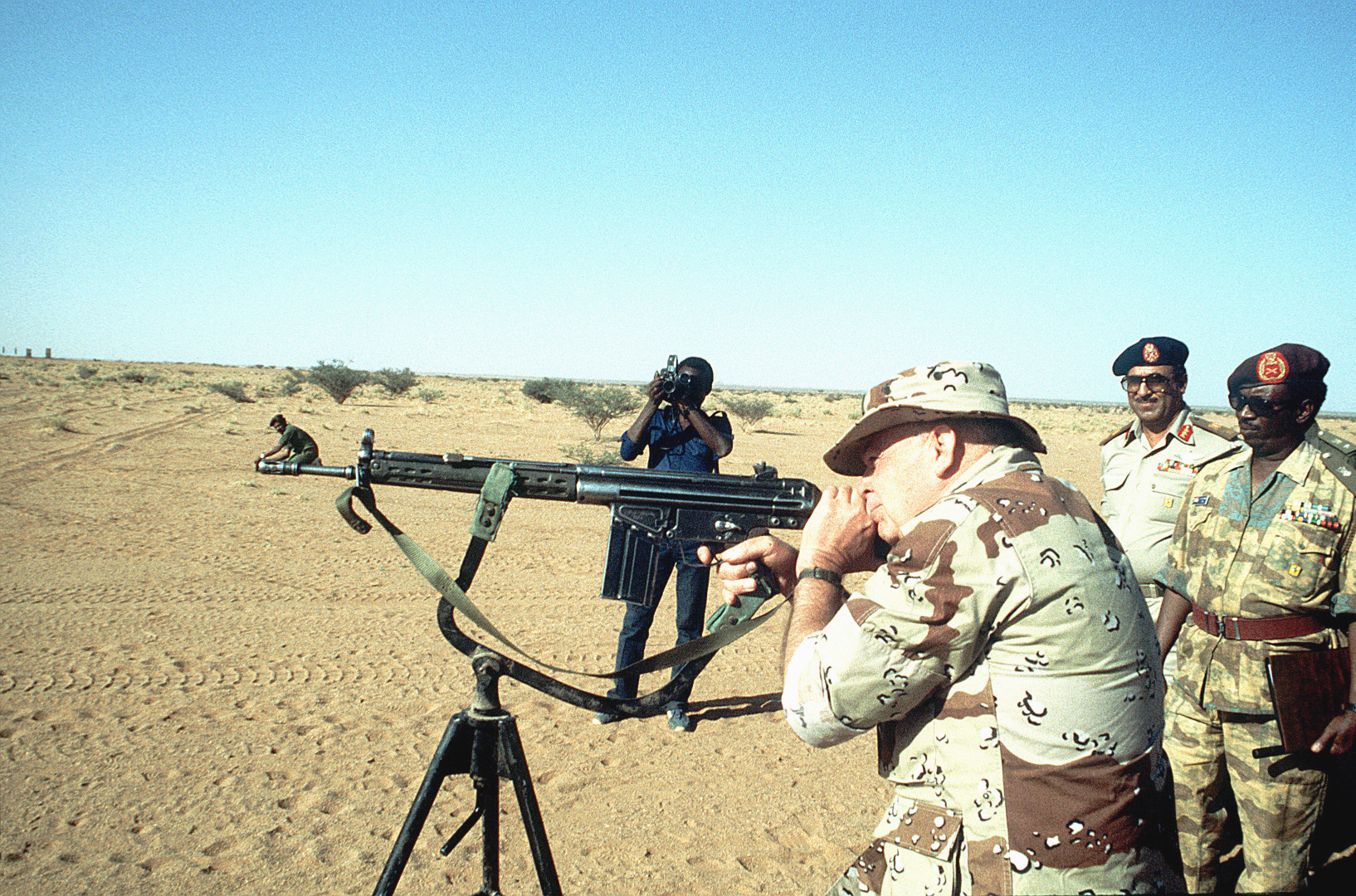
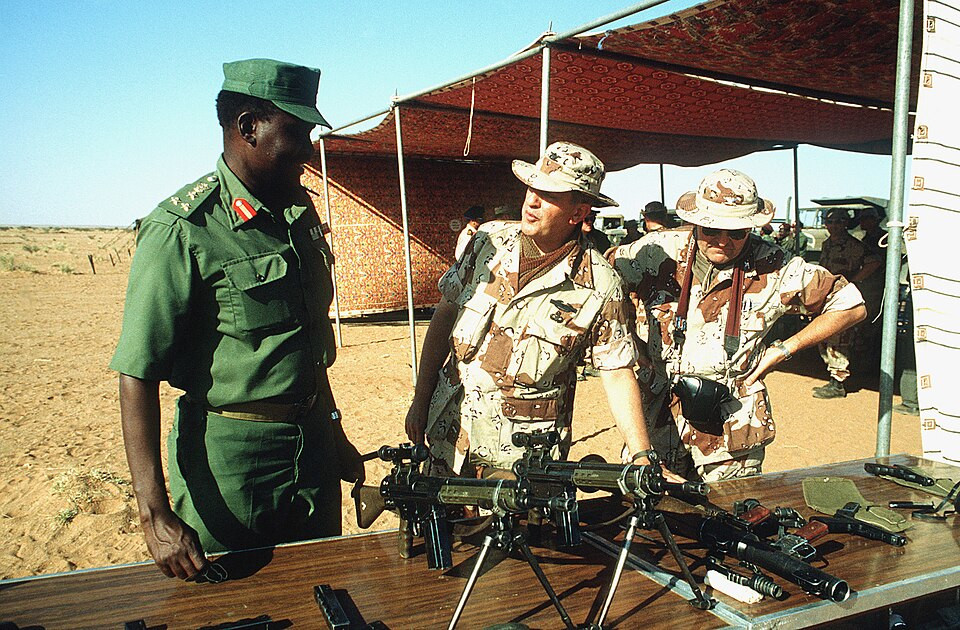
The standardization of German weapons in Sudan was facilitated through joint military exercises like BRIGHT STAR, a US-led multinational training program. Sudan participated in these exercises in 1981 and 1983, with the 1982 iteration moving to Sudanese soil for what British Pathé described as “the biggest ever military exercise” in Sudan.[5][6] These exercises trained Sudanese forces on Western weapons systems including the G3 rifle—just one year before the Second Civil War erupted in 1983.[5]
A high ranking Sudanese officer, left, and two Army colonels examine German built 7.62 mm G3 Heckler and Koch rifles on display during BRIGHT STAR ’82, an exercise involving troops from the US, Egypt, Sudan, Somalia and Oman. (Source: https://commons.wikimedia.org/wiki/File:Connels_were_showen_weapons.JPEG)
According to Rosa Luxemburg Foundation research, it wasn’t coincidental that the first shot triggering Sudan’s Second Civil War in 1983 was fired from a G3.[1] The pattern continued through the Darfur conflict of the 2000s, where militias armed extensively with G3 rifles committed mass atrocities that the International Criminal Court investigated in 2007, issuing warrants related to G3 supplies.[7]
The contested Darfur narrative
The early 2000s Darfur conflict became the subject of an unprecedented international campaign, but the narrative told by that campaign has faced serious scholarly challenge. Columbia University professor Mahmood Mamdani, one of Africa’s leading scholars, argued in his book “Saviors and Survivors” that the Save Darfur Coalition “substitute[d] moral certainty for knowledge” and presented a misleading picture of the conflict.[8]
The death toll itself remains contested. The Save Darfur Coalition and media widely reported 300,000-400,000 deaths. However, Mamdani pointed to UNICEF data showing approximately 200,000 total deaths, with only 20% from direct violence and 80% from starvation and disease related to drought and desertification.[9] He noted that death rates dropped dramatically starting in September 2004, falling below 200 per month by January 2005 and below 150 per month by 2008—a decline the campaign allegedly ignored because it undermined their “ongoing” narrative.[9]
Mamdani and other scholars like Alex de Waal and Julie Flint challenged the “Arabs versus Africans” framing, noting that both groups are native to Sudan, share language and religion, intermarry, and that the Janjaweed recruited from both Arab and non-Arab communities.[10] They argued the conflict stemmed primarily from land disputes exacerbated by decades of drought and desertification, militarized by Cold War-era weapons flows.
What’s undisputed: massacres occurred, villages were burned, mass displacement happened, and G3 rifles were prevalent throughout. The International Commission of Inquiry on Darfur found that ethnic groups involved weren’t significantly distinguishable due to shared religion and language, complicating claims of ethnic-based targeting.[11] Mass graves have been found, but not at the scale the highest death toll estimates would require.
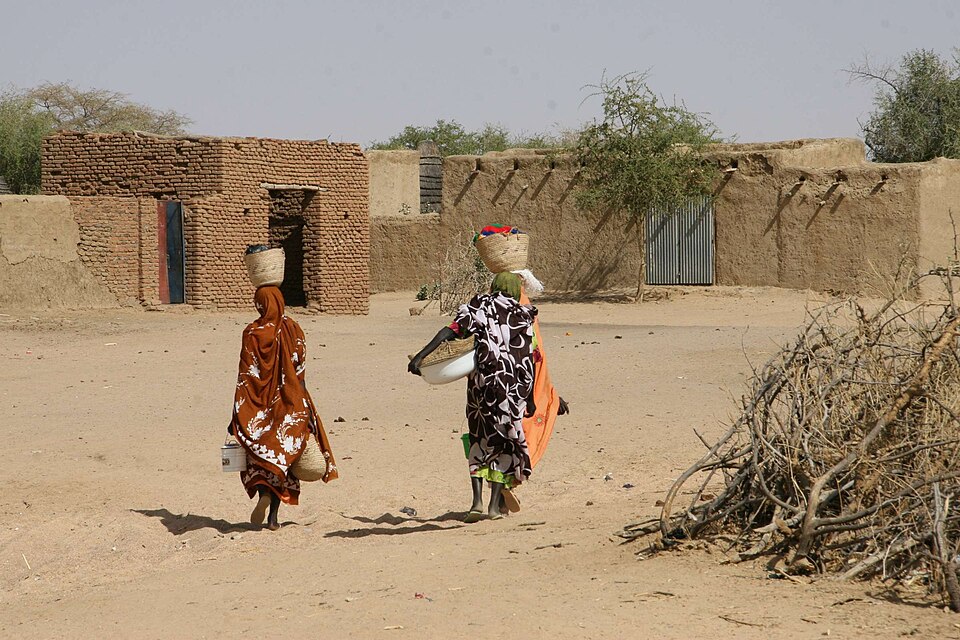
Women in Darfur (Source: https://commons.wikimedia.org/wiki/File:COSV_-_Darfur_2008_-_Women_in_daily_life.jpg)
The Save Darfur campaign: Who funded it?
The Save Darfur Coalition emerged in 2004 with backing from over 190 organizations. Initial driving forces included the American Jewish World Service, the United States Holocaust Memorial Museum, and evangelical Christian groups who had previously campaigned on Southern Sudan’s civil war.[12] The coalition later attracted black churches, student activists, and celebrity support including George Clooney and Mia Farrow.
With an annual budget of approximately $14 million, Save Darfur focused primarily on political lobbying for military intervention—not direct aid to Darfur.[13] Critics noted that “no meaningful part of its annual budget goes to help the needy in Darfur.”[13] The coalition pushed for no-fly zones and NATO intervention, which angered aid groups on the ground who said such actions could halt their operations and endanger workers.[8]
Mamdani argued the campaign instrumentalized atrocities to advance US interests in the “war on terror” and painted Sudanese Arabs as outsiders despite their being native to the region.[8] Whether one agrees with his critique, it’s clear the campaign prioritized changing US policy over understanding local complexities.
In 2015, as European leaders panicked about migration, Sudan’s President Omar al-Bashir made a strategic move: he redeployed militias from Darfur as “border guards” under the new name “Rapid Support Forces” (RSF). The RSF was formally integrated into Sudan’s army in January 2017, just as the European Union was seeking partners to “externalize” migration control.
Between 2014 and 2018, the EU channeled over €200 million into Sudan via the EU Emergency Trust Fund for Africa (EUTF) and the Better Migration Management (BMM) initiative.[14] The stated purpose was migration control and anti-trafficking. The reality was direct support to security forces that included the RSF.
As the Enough Project warned in 2017: “The gravest concern about the EU’s new partnership with Sudan is that the Rapid Support Forces (RSF), one of the most abusive paramilitary groups in the country, stands to benefit from EU funding.”[15] The report detailed how equipment meant for identifying and registering migrants would “reinforce the surveillance capabilities of a Sudanese government that has violently suppressed Sudanese citizens for the past 28 years.”[15]
The EU’s response? They claimed they provided “no financial support” to the Sudanese government, routing funds instead through NGOs and international organizations.[16] But multiple investigations documented that migration control operations were “to large extent assigned to” the RSF, and thousands of migrants were intercepted annually in RSF-led operations.[17]
When militia commanders become migration enforcers
Who exactly was receiving this EU support? Mohamed Hamdan Dagolo—known as “Hemeti”—the RSF commander who led forces during the Darfur conflict, was now positioned as Sudan’s primary migration enforcer for European interests. He wasn’t subtle about leveraging this position. In August 2016, he demanded the EU pay a “ransom” for RSF anti-smuggling work, threatening to “open the desert to migrants” if Europe didn’t appreciate RSF efforts.[17] In 2018, he warned again: “The European Union must recognise our efforts to fight against illegal immigration and smuggling. Otherwise, we will act differently.”[17]
The EU’s funding helped legitimize and strengthen the RSF at precisely the moment it was transforming from a militia into a state-within-a-state. Hemeti used EU-backed border control operations to build his power base, expand control over gold mines, and position himself as indispensable to both Khartoum and European capitals.
By 2019, when the RSF massacred over 120 pro-democracy protesters in Khartoum, the militia Europe had empowered was turning its guns on Sudan’s own people. Today, the RSF is locked in a civil war that has created what the UN calls the world’s worst humanitarian crisis—and both sides of that war are wielding G3 rifles, some marked with decades-old production stamps from German licensees.
The architecture of plausible deniability
Germany maintained arms embargos. The EU claimed it didn’t fund militias directly. But licensing agreements meant G3 production continued in countries like Saudi Arabia and Iran, creating “clean” supply chains divorced from German or EU responsibility. Migration funding went to “partners” and “implementing agencies,” with researchers noting “a lack of transparency” in how funds were channeled and spent.[17]
This architecture of plausible deniability—licensing arrangements that generate revenue while disclaiming responsibility, migration funding routed through intermediaries to avoid direct militia payments—creates a system where everyone profits while nobody is accountable.
Human Rights Watch documented RSF forces colluding with human traffickers rather than investigating them.[18] The US State Department concluded Sudan “does not fully meet the minimum standards for the elimination of trafficking and is not making significant efforts to do so.”[19] Multiple investigations found migrants reporting torture by RSF fighters, or discovering it was RSF fighters smuggling them in the first place.
And still, the funding flowed.
A pattern worldwide
Sudan is far from unique. The G3 has appeared in conflicts across the globe, documented in multiple theaters:
Iran-Iraq War: The weapon’s most sustained combat use, with Iranian forces relying heavily on G3 rifles throughout the 1980s conflict[20]
Syria: Used by Syrian Republican Guard forces, and later captured by various armed groups including ISIS[20][21]
African conflicts: Portugal deployed licensed G3 rifles during campaigns in Angola and Mozambique; after Portuguese withdrawal, some rifles armed Rhodesian forces during the Bush War[20]
Lebanon: Appeared throughout the Lebanese Civil War[20]
Each conflict represents not just Cold War legacy, but ongoing business relationships where licensed production, spare parts, and ammunition continue generating revenue.
What accountability looks like
This isn’t about collective guilt or historical blame. It’s about recognizing ongoing systems of profit and asking basic questions:
On weapons proliferation: Who continues profiting from G3 licensing agreements? What royalties or fees flow to German companies from rifles produced in Iran, Pakistan, Turkey, and Saudi Arabia? How do we reconcile intellectual property rights on weapons systems with responsibility for their use?
On migration policy: How did €200+ million in EU “migration management” funding strengthen militias that now lead one side in Sudan’s civil war? What oversight mechanisms failed? Who in Brussels signed off on designating militia commanders as migration partners?
On narrative construction: How did the Save Darfur campaign raise millions for lobbying while spending virtually nothing on actual aid? Why did the campaign ignore documented declines in violence that contradicted its ongoing narrative? What interests did oversimplified “Arabs versus Africans” framing serve?
On transparency: Why is it so difficult to trace where EU migration funds actually went in Sudan? Why do licensing agreements create such effective shields against accountability? Why do death toll estimates vary so wildly?
As Sudan faces catastrophic humanitarian consequences—over 30 million people dependent on aid, 16 million children in need of assistance, and 21.2 million facing acute food insecurity including 375,000 in famine conditions[22][23][24]—these aren’t academic questions. They’re about whether current systems of weapons commerce, migration externalization, and advocacy campaigns are sustainable, ethical, or ultimately self-defeating.
The human cost
Behind every policy decision, every licensing agreement, every migration funding allocation, every advocacy campaign, are people. Sudanese civilians caught between SAF and RSF forces, both wielding weapons that trace back to German designs and European money. Eritrean refugees detained by RSF “border guards” funded by EU migration programs. Darfuri communities displaced by conflicts whose narratives have been contested, simplified, and instrumentalized by various interests.
The G3’s story is ultimately about the long tail of decisions made in boardrooms and government offices in Germany and Brussels, in advocacy headquarters in Washington—decisions that seemed pragmatic, profitable, or politically expedient at the time, but whose consequences compound across decades and continents.
The question isn’t whether Germany, the EU, or Save Darfur intended these outcomes. The question is: now that the patterns are clear, and the critiques are on the record, what changes?
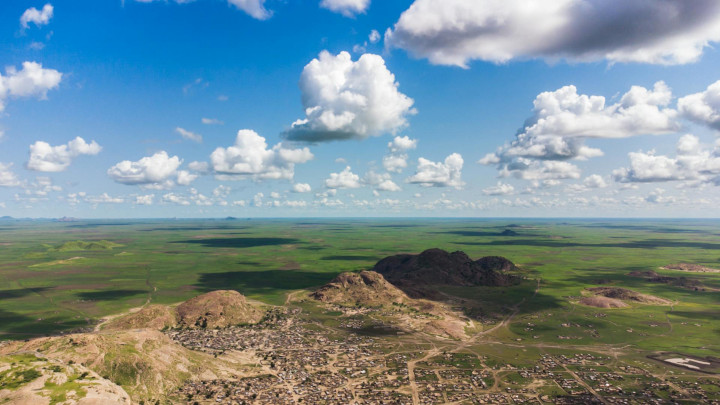
Baylah, Al Qadarif, Sudan (Source: https://www.pexels.com/photo/aerial-view-of-a-town-between-a-few-hills-on-a-flat-land-14348540/)
To provide the best experiences, we use technologies like cookies to store and/or access device information. Consenting to these technologies will allow us to process data such as browsing behavior or unique IDs on this site. Not consenting or withdrawing consent, may adversely affect certain features and functions.
Functional
Always active
The technical storage or access is strictly necessary for the legitimate purpose of enabling the use of a specific service explicitly requested by the subscriber or user, or for the sole purpose of carrying out the transmission of a communication over an electronic communications network.
Preferences
The technical storage or access is necessary for the legitimate purpose of storing preferences that are not requested by the subscriber or user.
Statistics
The technical storage or access that is used exclusively for statistical purposes.The technical storage or access that is used exclusively for anonymous statistical purposes. Without a subpoena, voluntary compliance on the part of your Internet Service Provider, or additional records from a third party, information stored or retrieved for this purpose alone cannot usually be used to identify you.
Marketing
The technical storage or access is required to create user profiles to send advertising, or to track the user on a website or across several websites for similar marketing purposes.